

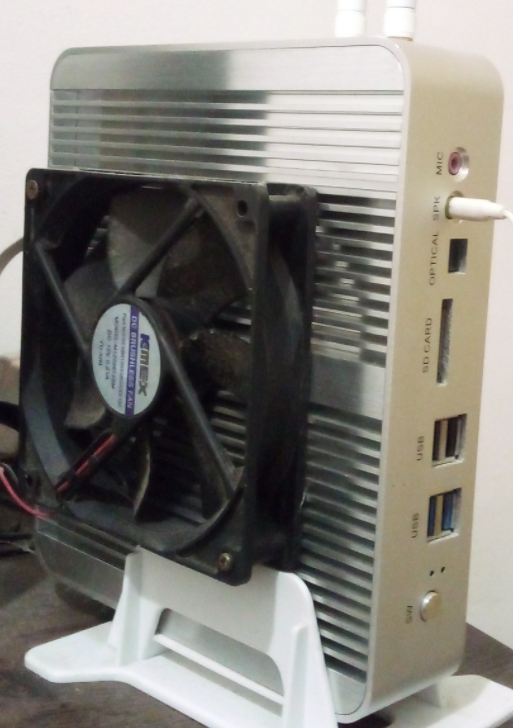
I got a pc that suffers from severe heating problems because of its poorly designed passive cooling case. I tried several strategies to put temperature under control, did a lot of tests with thermald, but ended up hacking a fan into the case. However, I still have problems with ssd temperatures.
Right now, as I write this, the nvme ssd is at 67ºC and easily goes beyond 80 or 90 during data transfers. I already lost 2 ssds before realizing this was the problem, because I was controlling just the cpu temperature.
There’s no physical way to force airflow where the ssd is, so I was wondering if there’s some way to throttle data transfer of something to prevent the ssd temperatures from reaching a threshold. All I could find was a vibecoded github repository. I don’t care if data transfer gets ridiculously slow, as long as the ssd remain safe, and I can’t consider getting any new hardware right now.
I’m currently running fedora 44 on that machine
Edit: I thought there was an easier software mitigation to that, but apparently, solutions will tend to the hardware side, so here are the hardware details:
- It’s an unbranded chinese cheap mini pc with a heat dissipation case that doesn’t dissipate well
- The ssd is mounted on the back of the motherboard. The model is a sandisk M.2 1TB 2280
Here’s a photo of the case, for the reference (don’t judge me lol):
And how’s that going considering 3 ssd failures and current idle temp of 67C versus the expected 40’s? You’re clearly not so dumb that you don’t know that a heatspreader will have its limits when you’re up against dead air so this is plainly what’s called being wilfully obtuse. And OP is the one who will suffer for it.
Funny, I’d liken your advice to putting a bandaid on a gunshot wound. But keep telling yourself you’re a trauma surgeon and not the janitor in a lab coat that OP was unfortunate enough to stumble into. Learn to admit when you’re wrong.
Based on what we know about the pc it’s going fine. The pc is still running. Were asked about how to fix a problem with an ssd.
You seem real bent out of shape about this. It’s not a big deal. The op got lots of advice and input, I sent them two links to heatsinks that will most likely fit just fine. Why not just wait and see how things turn out? There’s no need to continue to be insulting and confrontational.
Dumbass.
The knowledge and experience to reliably predict how this will end and empathy for anyone who has to deal with a PC sudden (or more likely slow and bizarre) death event.
Okay dumbass.
There is no reason to be aggressive, insulting and confrontational the way you are.
If you can’t make your point without resorting to personal attacks then consider not replying until you’re cooled off.
It’s pretty clear from what I said that I’m referring to the pc still running fine while multiple ssds have died.
From what I can tell the other components the op references are: the WiFi module. Unfortunately radio baseband chips were well into their implementation without any kind of heat mitigation era when this pc was manufactured. That’s another part that could likely benefit from sticking a heatsink on, lots of desktop motherboards and even some laptops have some kind of heatsink or pad coupling the radio to the chassis. Probably glue a nut to that too, straighten it right out. Radio is even more duty cycle dependent than ssds due to the nature of ip communication. It’s likely what drove thousands of devices to be designed without any way to deal with the heat from those little things. Why spend five times the cost of the chip sticking a sink on there when it’ll just automatically throttle down to protect itself was probably the engineering calculus.